
A B2B software company we worked with spent months getting excited about a new personalization tool. When it finally launched, every email pulled in the recipient's name, their company, their job title, even the last product page they had looked at. The marketing team was thrilled. Open rates climbed within the first two weeks, and for a while it looked like the investment had paid off. Then the sales team came back with the same complaint they'd had for a year: deals were stalling at the same point in the pipeline as always. Nothing about the personalization had changed why prospects went quiet after the second call. The company had bought a tool as part of a broader B2B marketing strategy and expected it to solve a problem that had nothing to do with email fields. Personalization and customer experience are not the same thing, and this is what it costs to mix them up.
• 73% of B2B buyers now expect the same personalized experience they get as consumers, but only 14% of large B2B firms say they deliver customer experience deep enough to lead their market
• Hyper-personalization is a set of tactics powered by data and marketing automation. Customer experience is the outcome of every interaction a buyer has with your company, including the ones no software touches
• 40% of B2B companies call personalization a major challenge, usually because they're personalizing content on top of a broken journey instead of fixing the journey first
• Account-based marketing programs succeed or stall on the same distinction, since personalized outreach to a target account means little if buyer journey optimization hasn't happened behind it
• Companies that lead in B2B customer experience grow revenue 4 to 8 percentage points above their market average
• The two work together only when personalization is built on top of a clear journey, not used to paper over gaps in one, which is the whole premise behind revenue marketing.
Hyper-personalization is the technical layer. It's the engine that pulls in first-party data, behavioral signals, and predictive models to change what a specific person sees, whether that's a subject line, a product recommendation, or a landing page. It's a tactic, and a genuinely useful one, which is exactly why most B2B demand generation teams fund it first. The ROI shows up fast in a dashboard, even when the underlying journey hasn't changed at all.
Customer experience is bigger than any single tactic. It's how a buyer feels after every touchpoint, from the first ad they see to the tenth support ticket they file two years into the relationship. Personalization can make one of those touchpoints better. It can't fix the other nine on its own.
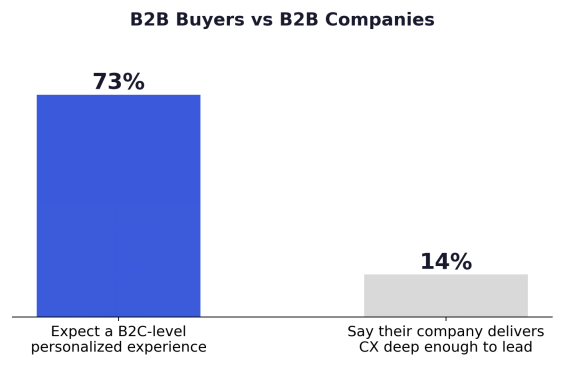
That gap between what buyers expect and what companies actually deliver is where most personalization budgets quietly go to waste. Salesforce research found 86% of B2B buyers are more likely to buy from a seller who understands their goals. That's a customer experience outcome. A personalized email doesn't create it by itself.
Most B2B companies don't set out to confuse the two. It happens gradually. Marketing buys a personalization platform because a competitor has one, often folded into an account-based marketing push aimed at a short list of target accounts. The platform ships with dashboards showing engagement lift, which looks like proof it's working. Meanwhile, the buyer is still getting handed off between three different reps who don't share notes, still waiting four days for a quote, still reading a proposal that ignores the one objection they raised on the discovery call.
None of that shows up in a personalization dashboard. It shows up in the deal that goes quiet, or the renewal that doesn't happen, and by then it gets blamed on price or timing instead of the actual cause.
Here's our honest read on this, not just a summary of the research above. Most of the hyper-personalization work we see going wrong isn't a data problem or a tooling problem. It's sequencing, again. Teams personalize the parts of the journey that are easiest to automate, like email and web content, while leaving the parts that actually decide the deal, like handoffs between sales and support, running on the same broken process they've had for years.
We'd rather see a client fix one handoff that's losing them deals than launch a fully AI-personalized email sequence on top of it. The email sequence is faster to ship and easier to show a board. The handoff fix is the one that actually moves the retention number.
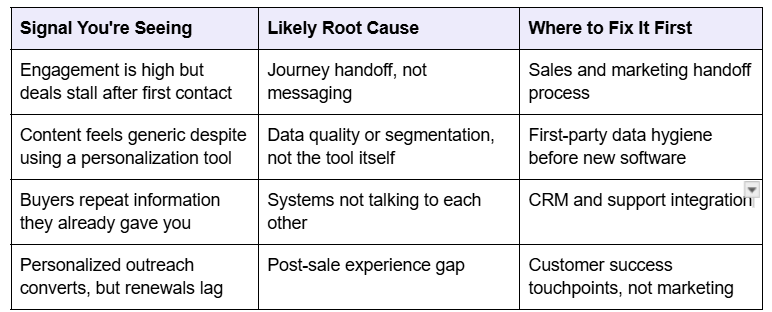
Before adding another personalization tool, map where the friction actually is. This is really a buyer journey optimization exercise more than a tooling checklist, and it's worked well with clients trying to figure out whether they have a personalization gap, a CX gap, or both:
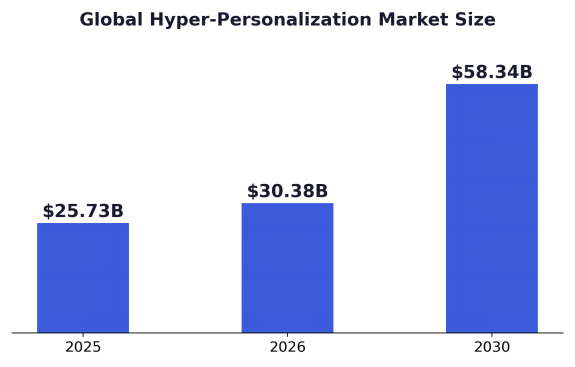
The hyper-personalization market is growing fast, and that growth is exactly why this distinction matters more this year than last. More vendors are selling more personalization tools into B2B companies that haven't necessarily fixed the journey those tools are supposed to sit on top of. Spending is about to outpace strategy in a lot of organizations, not because the tools are bad, but because the sequencing is backward.
A mid-sized B2B services company we worked with had decent personalization in place already, dynamic landing pages, segmented nurture emails, the usual stack. Their real issue was that leads who filled out a demo request waited an average of three business days for a follow-up call. We didn't touch the personalization layer first. We fixed the handoff so a rep reached out within four hours. Once that gap closed, the existing personalized content actually had a consistent experience to reinforce instead of a slow one to apologize for. Demo-to-opportunity conversion improved within the same quarter, without a single new tool added to the stack. That's the core idea behind revenue marketing: measuring the journey by pipeline and closed revenue, not engagement metrics alone.
Hyper-personalization changes what a buyer sees. Customer experience is what a buyer remembers after everything you did, said, and failed to follow up on. You need the second one working before the first one can do its job. Buy the personalization tools once the journey underneath them can actually hold up the promise they're making.
We're Rovert Digital, a digital growth agency that builds B2B marketing strategy, demand generation, and customer experience around one connected buyer journey, instead of three separate initiatives. If you're not sure whether your team has a personalization gap, a customer experience gap, or both, that's exactly what we look at first. Get your customized plan and see where the gap actually is before you spend another dollar closing the wrong one.
1. What is the difference between hyper-personalization and customer experience?
Hyper-personalization is the data-driven tactic of customizing content to an individual; customer experience is the overall outcome of every interaction a buyer has with your company.
2. Why doesn't personalization improve B2B conversion rates on its own?
Personalization only changes what a buyer sees, so it can't fix broken handoffs, slow follow-ups, or other journey gaps that actually stall deals.
3. How do I know if I have a personalization gap or a customer experience gap?
Check where the friction actually happens: high engagement with stalled deals points to a journey gap, while generic content despite personalization tools points to a data or segmentation gap.
4. Does hyper-personalization help with account-based marketing?
Yes, but only when it's built on top of a clear buyer journey; personalized outreach to a target account does little if the journey behind it is still broken.
5. Should I invest in a personalization tool or fix the customer journey first?
Fix the journey first, since personalization tools only amplify an experience that already needs to hold up on its own.


