
If you're reading this, you've probably already tried the usual playbook: gated ebooks, a paid social push, a new marketing tool, maybe even a rebrand. The pipeline still feels thin. Sales still say the leads aren't good enough. Here's what the research says is actually happening while that playbook runs: most B2B buyers have already picked a winner before anyone on your team hears from them.
That's not a guess. 6sense's 2025 Buyer Experience Report found 94% of buying groups rank a preferred vendor before ever contacting sales. Gartner's 2025 research puts the share preferring a fully self-service process at 61–70%. Two different firms, two different methodologies, the same uncomfortable conclusion: most of the tactics teams reach for first are aimed at the wrong stage of the decision entirely.
Each of these tactics is reasonable on its own. The problem is timing: most of them are built to capture buyers who are already comparing vendors, while the research below shows the deal is usually decided before that stage even starts.
1. Gated ebooks and whitepapers
6sense's research on vendor selection found buyers rule out companies that force a form just to access basic information, self-serve completeness is a top factor in making the shortlist
2. Paid social and display ads
Buyers now research across 10.2 channels on average, up from 5 in 2016, so budget concentrated in one or two paid channels reaches a shrinking share of the real research process
3. A new marketing automation tool
Tools help you run campaigns faster, they don't fix a mismatch between where the buying committee spends attention and where your content lives
4. A rebrand or new messaging
Buying committees have grown from 7 stakeholders in 2017 to 11 in 2024 (Gartner); one polished message rarely reaches every role in a group that size
Underneath all four of those attempts is usually the same root confusion. Lead generation collects contact details from buyers already searching for a solution. Demand generation builds awareness and trust across the much larger group who aren't ready yet, so your company is the one they already trust once they are.
Most teams run lead-gen tactics, gated content, forms, cold outreach, and call it demand generation. That reaches only the small slice of buyers ready to act today. The much larger group who'll be ready in three, six, or twelve months never hears from you, and by the time they are ready, they've already formed an opinion, usually without you in the room.
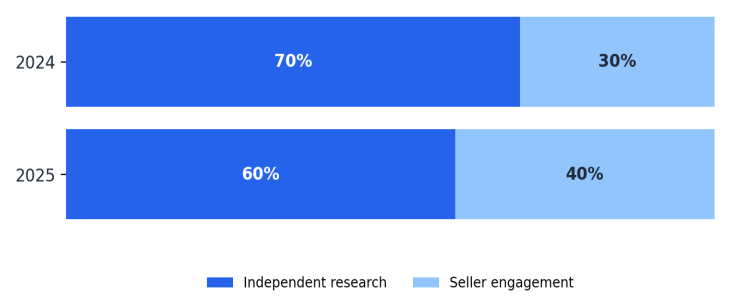
The independent-research share of the buying journey moved from 70% to 60% of total buyer time between 2024 and 2025, not because buyers wanted less contact with vendors, but because AI-assisted research let them compress that homework into a shorter window. They're reaching out to sales earlier, but mostly to confirm a decision already in motion.
It's tempting to read the above as “just add more channels.” But the committee problem compounds the channel problem. Gartner's research shows the buying group itself has grown substantially in less than a decade.
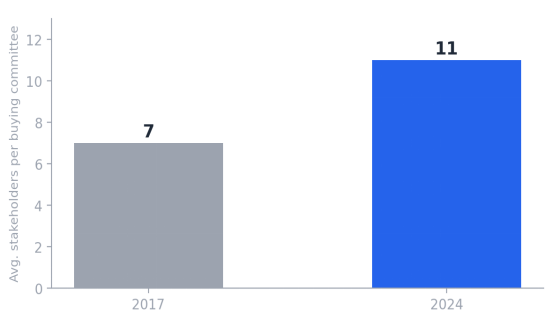
More stakeholders, more research channels, less time for sales to shape the outcome. That direction is consistent with Forrester's prediction that more than half of large B2B transactions would move through digital self-serve channels. Three research firms, three methodologies, one direction of travel.
Get a free visibility check across search, review sites, and AI-referenced sources.
It would be easy to read all this as “replace sales with content.” The data doesn't support that either. In the same 2026 Gartner survey, 69% of buyers said they still turn to a rep specifically to validate what they'd already found through AI-assisted research. Self-service didn't remove the seller, it moved the job from informing to confirming.
That's the real fix hiding underneath “what you've tried” not working: it's rarely a sales problem, and it's rarely solved by a new tool or a rebrand. It's a timing problem. Your best content needs to already have done the persuading by the time a human conversation starts.
6sense asked buyers directly what made a vendor the early favorite. Three answers came up consistently:
1. They prove they understand the buyer's business before any sales call. In the content, case studies, and product pages a buyer reads unprompted, before your team knows they're evaluating you.
2. Their self-serve information is genuinely complete. Pricing logic, technical documentation, integration details, and comparison data are accessible without a gate.
3. They show up in sources the buyer already trusts. Analyst write-ups, peer discussions, community threads, and increasingly, the summaries AI tools generate when a buyer asks for a comparison.
This is where the research meets our own client work, and it's worth separating the two clearly: the numbers above are external research, this part is our direct experience running visibility audits for B2B clients. When we take on a new account, one of the first things we do is a self-serve audit: we act as an anonymous buyer, try to answer our own pricing, integration, and comparison questions using only what's publicly available, and log every point where we'd have been forced to fill out a form or make a call just to keep researching.
Across the audits we've run this year, the most common failure point isn't content quality, it's content access. Teams write good case studies and then gate them. They build detailed pricing logic and then hide it behind a “talk to sales” wall. The content existed. The buyer never reached it before ruling the vendor out, which looks, from the outside, exactly like “demand generation isn't working.”
A mid-market SaaS client came to us converting leads at a normal-looking rate, but losing an unusual share of “engaged” opportunities late in the cycle, the classic “we tried everything” symptom. Our self-serve audit found the gap fast: pricing and integration detail were gated behind a form, and the company had no presence in the comparison content buyers were actually reading on third-party review sites. Buyers were ruling them out during anonymous research, weeks before a rep ever got a call, and the CRM had no way to surface that, because it only captured activity after someone converted.
What buyers used to need - What buyers do now
1. A sales call to get pricing and specs - Self-serve access, or they move on
2. Vendor site as the main research source - 10.2 channels on average, including AI tools
3. A sales conversation to shape the shortlist - A shortlist set before sales is contacted, 94% of the time
4. Committees of 7 stakeholders (2017) - Committees of 11 stakeholders (2024)
We're Rovert Digital, a holistic digital growth agency. The pattern above, buyers deciding before sales ever enters the picture, is the single biggest thing we help B2B teams across North America respond to, because it changes what actually deserves budget: not another tool, another rebrand, or more sales follow-up, but real visibility during the research window most teams aren't tracking at all.
If any of the tactics above sound like your last twelve months, that's exactly what we'd look at first.

1. Why isn't gated content generating quality leads anymore?
Gating pricing, docs, or case studies is one of the top reasons self-serve buyers rule out a provider early, before they ever fill out that form.
2. What's the actual difference between demand gen and lead gen?
Lead gen captures buyers already searching for a solution; demand gen builds trust with the much larger group who aren't ready yet.
3. Does AI research mean sales reps matter less now?
No, 69% of buyers still consult a rep, just to validate what they've already found through AI-assisted research, not to start the conversation.
4. Why doesn't adding more marketing channels solve the problem?
Buying committees grew from 7 to 11 stakeholders since 2017, so more channels alone can't reach every role without the right content in place.
5. How can we tell if buyers are ruling us out before contact?
A self-serve audit - trying to answer your own pricing, integration, and comparison questions as an anonymous buyer - usually reveals the gap fast.


